
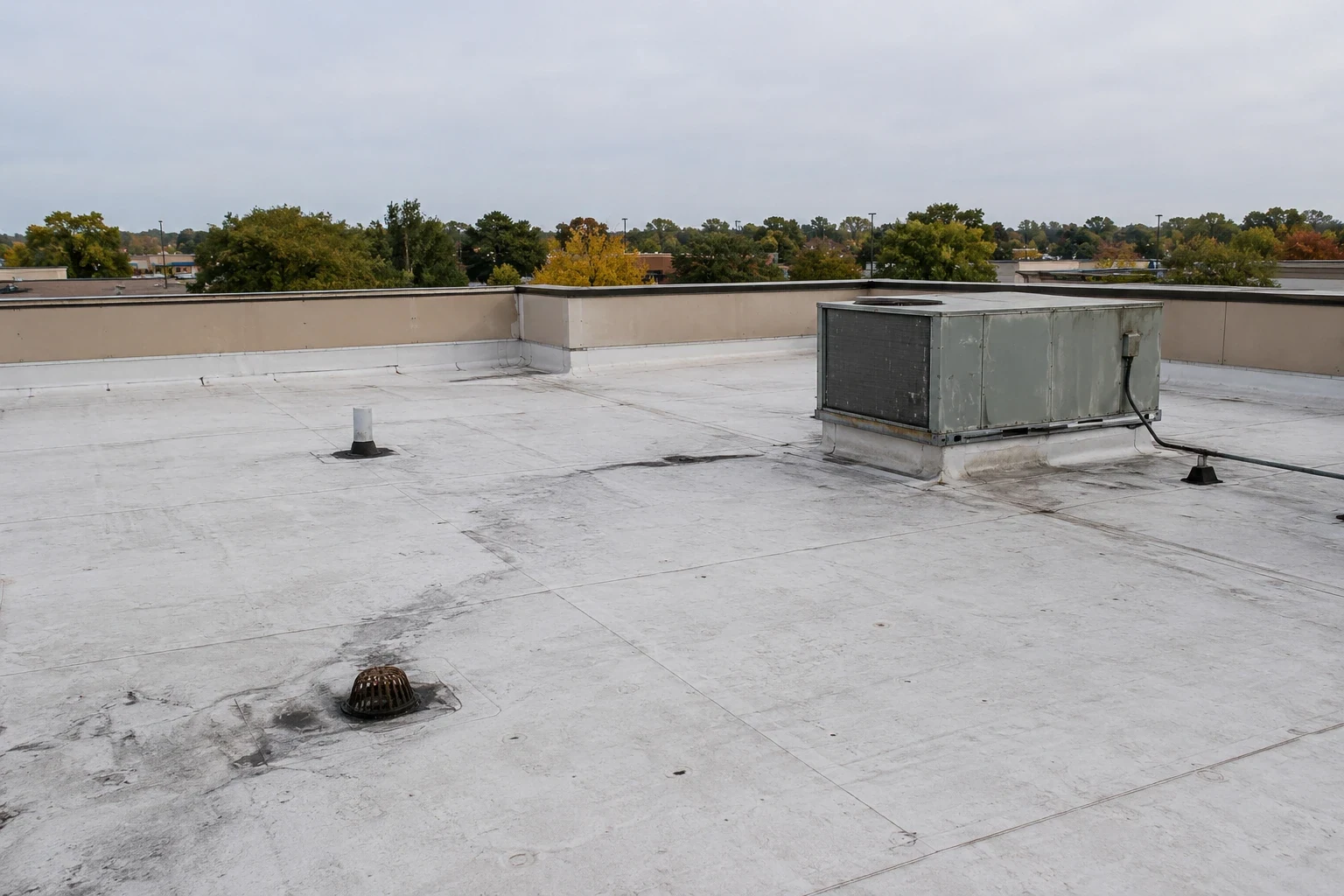
Retail and Restaurant Chains
Coordinate roofing by store location
A store roof shares its workday with customers, deliveries, staff and equipment that may stay in service. In Lakewood, CO, we start with the location list, trading hours, kitchen exhaust or rooftop units, delivery windows, leak reports and approved access. We divide the roof into work zones and coordinate a lift, material drop and daily closeout that keep the public route clear. Each location receives its own condition record so a chain-wide program does not assign one building’s detail to another.
Lakewood’s retail settings include Colorado Mills, a 1.4-million-square-foot regional mall; Denver West Village, a 310,000-square-foot retail center; and Creekside at Colfax and Wadsworth, where five pads surround a 220,000-square-foot Walmart and the shops and restaurants occupy about 37,000 square feet. Belmar is another mixed-use downtown hub. The property survey measures each roof and confirms loading rules with its manager.
How should work fit the store’s open hours?
The property contact identifies customer entrances, accessible routes, loading, fire access, staff areas, patio seating, shopping-cart paths and hours when a delivery or lift can use the site. At a multi-tenant center, we coordinate the affected bays and shared property rules before naming a staging zone. At a stand-alone restaurant, exhaust, grease service and food deliveries may shape the roof route. The approved map connects the work area with the rooms below and the perimeter route customers continue to use.
Roof production is split into phases that can be opened, protected and secured within the agreed window. We record the location of temporary covering, open flashing details, equipment clearances and the point the manager must inspect before the next section proceeds. If weather or a concealed condition changes the planned boundary, we update the facility contact and secure the approved area before adding work. Daily closeout names what is complete and what remains restricted.
Colorado Mills and Denver West Village are documented large retail assets, while Creekside combines a major store with shop and restaurant pads. A shopping-center roof scope can address shared tenant and customer circulation, and a restaurant building plan can identify kitchen exhaust and service access. A hospitality property sequence can account for guest arrivals and occupied rooms.
What should a chain location inspection identify?
We inspect the membrane or panels, seams, flashings, penetrations, curbs, drains, scuppers, parapets and previous repair areas. For restaurants, we note the visible roof interface at exhaust and service equipment, without operating or altering the kitchen system. Managers can provide interior leak locations and identify stock, food-preparation or point-of-sale areas that need protection. The report maps each finding to a roof section and photograph, then states whether it is confirmed, needs testing or should be watched.
A portfolio record should keep store number, address, roof zone, work history and unresolved condition together. If drawings use a different location name than the operator’s system, we can include both identifiers in the report. Roof additions and separate structures remain distinct rather than being averaged into one condition grade. If a survey cannot reach an area, the record names the access step needed to finish it.
A location-level inspection can produce the baseline. The multi-site roof program can track visits, proposals and completed work across stores while preserving each property’s findings.
When can a leak be repaired without closing a location?
A localized repair may address a puncture, split seam, curb, penetration, drain or flashing detail where nearby materials remain serviceable. We establish the entry path from roof and interior evidence, then set a boundary for the patch and any testing still needed. A temporary measure may control active water while a permanent detail or safe work window is arranged. The store manager receives the status of the temporary protection and the return work that remains.
Opening the assembly can reveal wet insulation or damaged deck beyond the visible defect. In that case, we stop at the approved boundary, document the condition and route added removal for review. The operator can choose a revised repair or compare broader renewal after the exposed area is understood. If a recover is considered, moisture, substrate, attachment, added height, drainage and equipment clearances must support another layer. Tear-off may be appropriate where those conditions do not.
An urgent roof response can stabilize active entry. A flashing correction can address a confirmed perimeter or penetration detail.
How do replacement phases work across a chain?
We sequence stores by condition, approved budget, access window and readiness of site information. Each proposal lists removal, insulation, attachment, edges, curbs, drains, disposal, equipment coordination and customer protection. Work at one property can proceed while another remains in survey or testing, provided the portfolios retain clear site identifiers. Material deliveries and lift use are confirmed with each center or store contact instead of being assumed from a regional schedule.
Cost and duration depend on verified roof area, existing layers, deck repairs, insulation, curb height, perimeter details, disposal, staging and the number of phases. For a restaurant, exhaust equipment, fire-suppression coordination and service clearances can affect the sequence. For a retail center, shared drive aisles, loading and tenant notices may control when an area can be accessed. These conditions belong in the location-specific scope and closeout.
A replacement estimate can be compared with a recover only when survey findings support it. A property management coordination plan can route notices and access permissions across leased sites.
Which Lakewood conditions should store managers track?
Lakewood’s hazard assessment treats hail plus extreme heat and cold as near-term risks for commercial property. A hail review separates punctures, displaced details or interior reports from surface marks and ties confirmed items to roof zones. Heat can restrict safe working periods and material handling; cold can affect adhesive application and cure. A project log records the task held, protection in place and next approved work window so the store can plan deliveries and customer notices.
Store design review carries two Lakewood benchmarks, both 30 psf: ground snow and the minimum roof snow/live load. The project’s structural review sets the applicable capacity and attachment details for each store. Ice over a retail roof can make a route unsafe and hide drainage details, leaving a location visit incomplete until conditions change. The site contact receives a note on which area was not reached and what review remains before the roof condition is treated as complete.
A hail roof review can support location-specific documentation after a storm.
Related Roofing Work
Questions About Retail and Restaurant Chains
Can work happen while a store is open?
We map customer routes, deliveries, fire access and the roof section planned for that shift. The site contact approves the window and barriers, and each phase ends with a recorded protection check.
How do you handle roof equipment above a restaurant?
We document visible flashing and clearance conditions, then coordinate any shutdown or adjustment through the restaurant’s assigned equipment provider. Roofing scope does not authorize changing kitchen equipment.
Can one service contract cover several locations?
A shared program can use common reporting and scheduling fields. Each property still receives its own inspection, repair boundary, access notes and estimate.
What if a repair requires a longer closure than expected?
We stop at the approved work line, secure the area and explain the condition that changed the scope. The manager and owner review added time or protection before the next zone opens.
Which location records should a chain keep?
Keep the site identifier, roof map, inspection photos, repairs, access notes, warranty documents and unresolved tests together. We can return the closeout against those same property fields.
Talk with our Lakewood roof team
Send the Lakewood location list, roof records, trading and delivery hours, equipment schedules, known leaks and center access rules. We will map the survey and phase sequence for each property.