
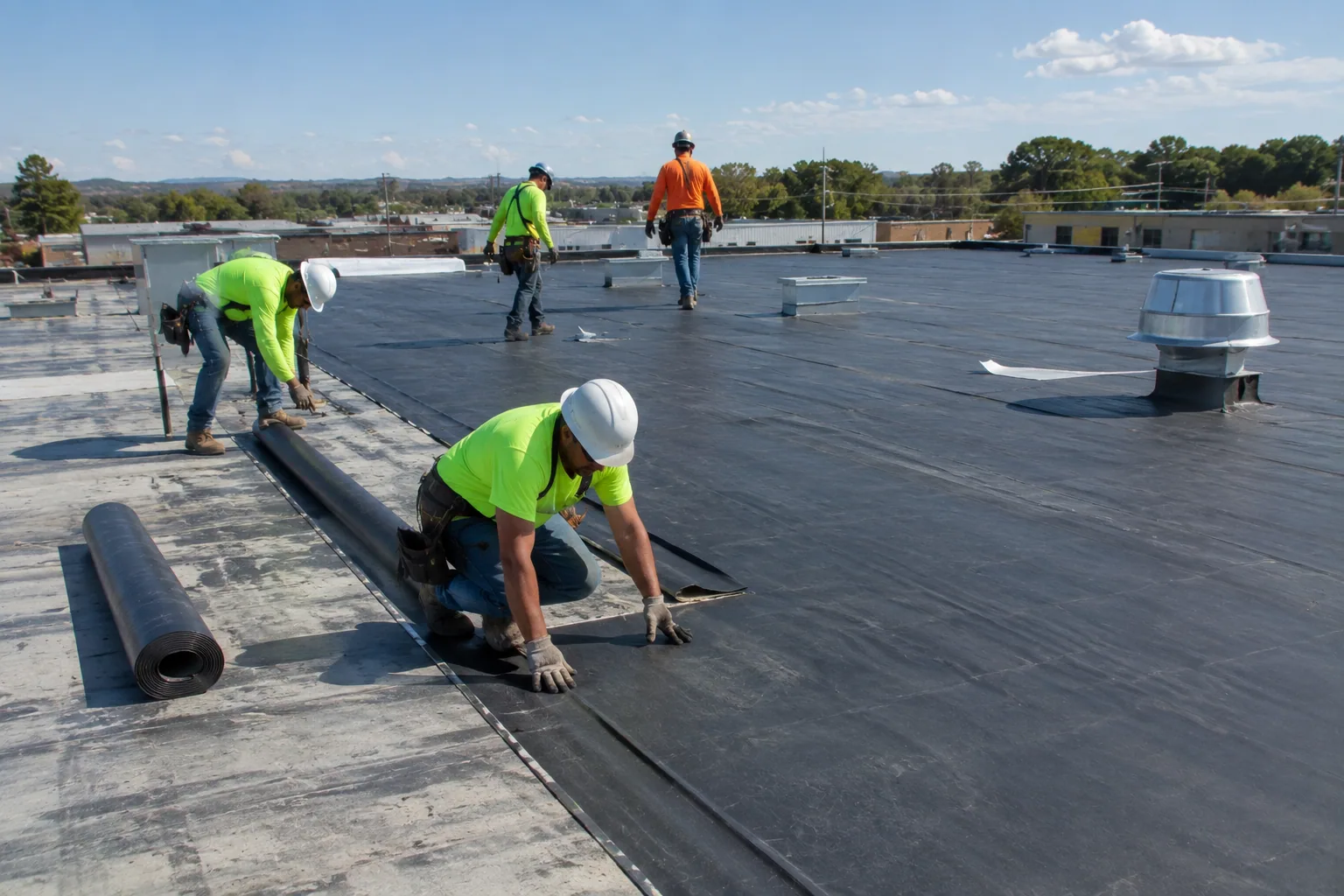
EPDM Roofing
Review an EPDM Roof in Lakewood
A membrane’s repair history can matter more than its age label when an owner is deciding whether to patch, recover or replace. For a Lakewood, CO commercial roof, we identify the EPDM assembly, inspect seams and flashings, and note where prior work or rooftop traffic has changed the surface. EPDM is a flexible synthetic-rubber membrane used in low-slope assemblies. Its field seams, perimeter terminations and penetration details require materials and preparation suited to the installed system.
Lakewood’s West Alameda and Belmar corridor includes mixed retail and downtown uses. The Sheridan Station area brings transit-oriented commercial planning and its own access considerations. We plan around the property’s actual route, occupied areas and equipment windows.
What condition details should be recorded?
We examine the membrane for splits, punctures, shrinkage, wrinkles, open laps and surface changes around patches. At walls and curbs, we check whether flashing remains secure and whether terminations can move with the assembly. Drains, scuppers, skylights, pipe boots and roof edges receive separate attention. The report locates each observation by roof section and says whether it is a repair item, a test question or an area to monitor.
EPDM seams may use tape, primer, adhesive or system-specific accessories, depending on the installation. A repair should follow the membrane manufacturer’s requirements and account for surface contamination or aging. A baseline inspection can map defects before a larger scope; targeted repair can correct a defined seam or flashing failure. If water appears inside, the visible ceiling location does not necessarily identify the membrane opening, so the path should be traced.
How are seams, patches and flashings restored?
Preparation begins with identifying the membrane and removing contamination that would interfere with adhesion. The crew uses compatible primer, tape, cover strip, uncured flashing or other specified materials for the detail. A patch extends beyond the defect onto sound, prepared membrane, with corners and terminations treated as the system requires. We identify which repairs can be made from the surface and which need a larger opening to evaluate insulation or deck.
At a curb, wall or pipe, the transition must remain secure as materials move through temperature changes. We inspect prior patches and decide whether the repair can tie into sound EPDM or needs a rebuilt flashing detail. Curb and penetration work can address raised openings, while perimeter work can restore the edge termination. A new surface patch is not a substitute for correcting a loose or poorly formed termination.
What does Lakewood weather change?
Lakewood faces near-term extreme cold, hail and heat hazards. Cold limits safe roof access and can change the preparation and application window for adhesives or primers. Hail review should record visible impact or exposed reinforcement without treating every mark as a membrane puncture. We state the weather and surface conditions that applied during the visit and defer work where the product instructions cannot be met.
In the Sheridan Station hub, transit and nearby commercial activity can affect crew parking and material movement; in West Alameda and Belmar, a mixed-use schedule may place different limits on the same roof route. A storm review can document broader impact, and infrared imaging may guide sampling when insulation moisture is suspected. Each method has a separate question and a defined coverage area.
When should EPDM be repaired, recovered or replaced?
Localized seam or flashing defects on a stable, dry assembly may fit a repair. A recover may be possible when the existing layers, attachment, moisture, drainage and height transitions meet project requirements. Widespread wet insulation, brittle or separated field membrane, recurring failures, deck damage or poor perimeter details can move the comparison toward replacement. We use inspection and testing to define those boundaries instead of relying on a generalized life estimate.
Each option has different removal, disposal, insulation and transition quantities. Recover evaluation tests whether existing material may remain, while replacement planning defines the tear-off boundary and new assembly. Owners comparing systems can consider TPO or modified bitumen alongside EPDM according to specifications, roof use and maintenance needs.
How is EPDM work phased at an active property?
The field sequence lists access points, crew route, staging zone, material drop, rooftop equipment, tenant window and a secure stopping location. We confirm which drains remain active and how the crew will carry materials without crossing an unprotected membrane. A section is not opened until the day’s tie-in can be completed or the approved temporary protection is ready. If the surface is wet, icy or otherwise unsuitable, the contact receives the affected boundary and revised work window.
Rolls and repair products are staged in a dry, protected area and carried to the active section in the planned quantity. We check that equipment technicians have a route to service units, and mark any area where temporary walk protection is part of the approved scope. Before leaving, the crew confirms that drains and outlets are clear of packaging and debris and that exposed terminations have the specified end-of-day protection.
Closeout photographs show the section before and after repair, the seam or detail changed, materials used and any open item. When the roof is part of a multi-building property, the same section labels carry through inspection and future service. The asset manager can then compare recurring repair points and decide whether they remain local defects or signal a broader renewal need.
What should the owner keep with the roof record?
Retain the assembly description, product information where available, seam and flashing repairs, photographs, test locations, exclusions and maintenance notes. The map should identify equipment and access paths that affect future inspection. If a warranty applies, record the repair approval or inspection requirement supplied by the owner or manufacturer before work begins.
For a property with several membrane types, the roof inventory should list EPDM separately from other assemblies, even when they share a building. Different seam materials and repair products may require different preparation. A clear location label prevents a future work order from directing the crew to the wrong roof section or assuming that one repair method applies across the whole address.
Send roof plans, prior repair notes, leak history, warranty information and tenant access rules. We will identify the installed EPDM configuration, inspect its transitions and return a repair, recover or replacement recommendation with a measurable scope. The closeout records what was completed and what still needs investigation.
Related Roofing Work
Questions About EPDM Roofing
Can every EPDM seam be resealed with adhesive?
The seam method depends on the installed system and its condition. We identify the membrane and use the specified preparation and compatible materials for the repair detail.
Can EPDM shrink away from a parapet?
Movement or stress at a termination can expose the flashing connection. We inspect the field, wall and termination together before defining whether a patch or rebuilt detail is needed.
Can EPDM be installed over another membrane?
A recover needs confirmed layer count, substrate, moisture, attachment and compatible transitions. Testing and project requirements set which areas may remain in place.
Does black EPDM make a building hotter?
Roof surface temperature is one part of building performance. Insulation, ventilation, HVAC, interior loads and climate also matter, so a project comparison should use the complete assembly.
What should be inspected after a hail report?
We photograph visible impacts, splits, punctures and affected details, then identify any area needing closer testing. The report separates observed damage from a cause that remains uncertain.
Talk with our Lakewood roof team
Share roof plans, repair history, leak reports, warranty requirements and access windows. We will map seam and flashing conditions and define the next scope by section.